JOURNAL: CONSOLIDATING A VERNACULAR
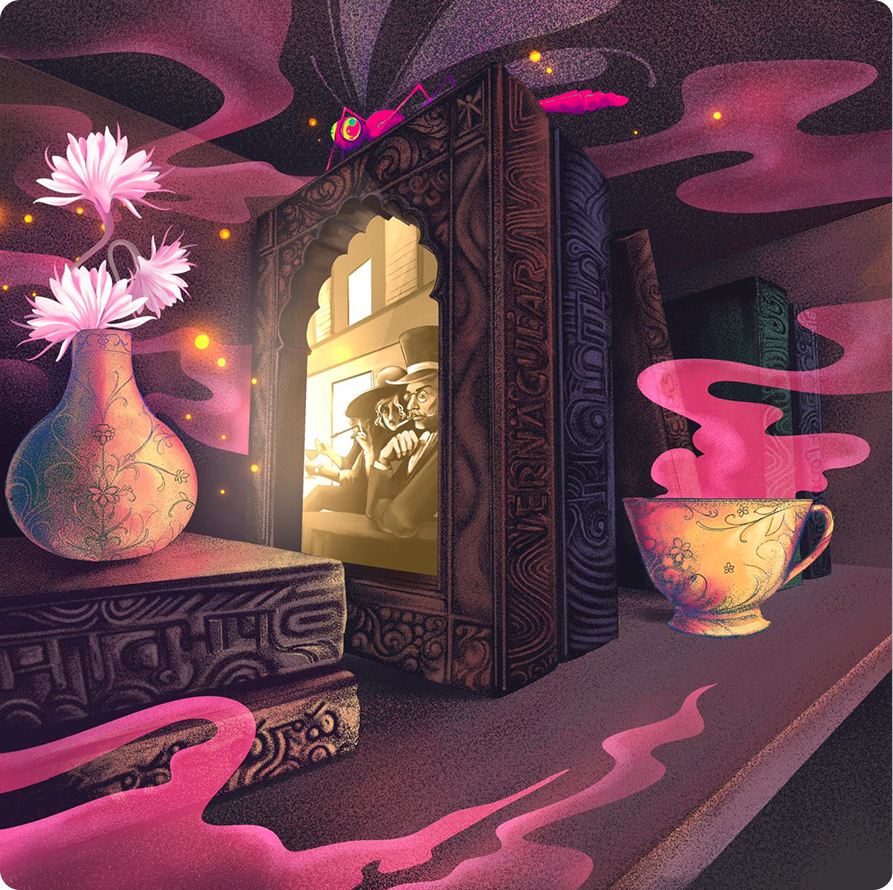
Illustration by Aditya Damle
ENTRY #01:
LAND
2025-06-07
Words by Jones Benny John
When travelling through Wayanad, it is hard to not notice how coffee trees litter the landscape, lining most unforested roads and, more often than not, the horizons of its settlements. It is easy to mistake coffee to be indigenous to the Western Ghats, especially for those of us who played at keeping vigil over our elders’ farms, armed with catapults to stay invading troops of monkeys from eating the Christmas crop. Back then it could never cross my mind that our coffee might come from elsewhere, just as I could never imagine my grandparents to have ever lived anywhere else.
As I grew up, I began noticing my uncles and aunts referring to our “nadu”, or our “land”, which was revealed to be far from where I spent my Christmas vacations. I learnt we did not belong to Wayanad, but had come here to escape famine in search of literal greener pastures. My grandparents had grown up in the villages of Travancore, and were amongst the scores of migrants who were guided by the church to take up farming in the Malabar. Coffee already existed in these ghats back then, first planted by the British in the 1830s, then propagated by landowning families from Mysore and Cannanore who were quick to understand the crop’s economic potential.
Tea estates began to be developed when Coffea arabica began to decline globally due to the notorious leaf- rust epidemic, but coffee regained popularity with the introduction of Coffea canephora, a species which was developed in Peradeniya in Ceylon, to Wayanad.
Chachan, as we called our paternal grandfather, trekked up to Wayanad first in the 1920s with his father and brothers, and, like their neighbours from Travancore who had had settled around Chundapadi-Moovetil, bought canephora seeds from a prominent Moplah family who had already established themselves in the area. Over the next hundred years, they would go back to Travancore only return to Wayanad yet again as the region was populated by others from their community, Wayanad would accede into the newly formed state of Kerala along linguistic lines as influenced by these migrations, more roads and townships began to appear on land that was once forest, and labour movements led by the Left would see the departure of estate owners whose vernaculars were not Malayalam away from the region. Through it all, more coffee blossoms could be discerned across the landscape, year after year.
The first time I, like others from the subcontinent, came across the word “vernacular” would have been in the context of language, while studying about colonial-era restrictions imposed on “vernacular” periodicals. It was easy to presume then that the word could describe an intrinsic and timeless sense of belonging to the land but as I understood language to evolve with time, associating timelessness to the word became difficult. The “vernacular” was not necessarily indigenous, I thought, but it wasn’t simply an export either.I stumbled across the word again in art and design school through the notion of visual “vernaculars”, a phrase used to describe hand-painted signboards, advertisement murals and other instances of graphic design that populate our everyday, that defines the cityscape as a cohesive aesthetic. The “vernacular” now developed into what characterises our shared spaces, in how they are perceived through our senses.
The “vernacular”, by this understanding, becomes the means by which culture may be experienced. The rural landscape, as in Wayanad, is not as densely populated by hoardings and vinyl stickers, but by crops whose cultivation defines life’s rhythm for their associated communities. Here, cultivation defines culture, and thereby its vernaculars.
Chachan and his brothers climbed the churram, or ghat road, from Thamarassery that was built some hundred years earlier by the British East India Company, as directed by a Paniyar elder named Karithandan who intimately knew the lay of the land. The story goes on to tell us that the engineer in charge, in an attempt to secure credit solely for himself, murdered their guide, provoking his angry spirit to haunt the road for some decades before being chained to a bodhi tree where the churram ends. As Nasaranis, as Travancore’s’s so-called Syrian-Christians identify themselves in the “vernacular”, began settling beyond this bodhi tree a hundred years later, their seasonal markers, such as advent and lent, found themselves entwined with the farming cycles of the various cash crops, particularly coffee alongside pepper, vanilla and cacao, that was being nativized in the region through these migrations.
