JOURNAL: CONSOLIDATING A VERNACULAR
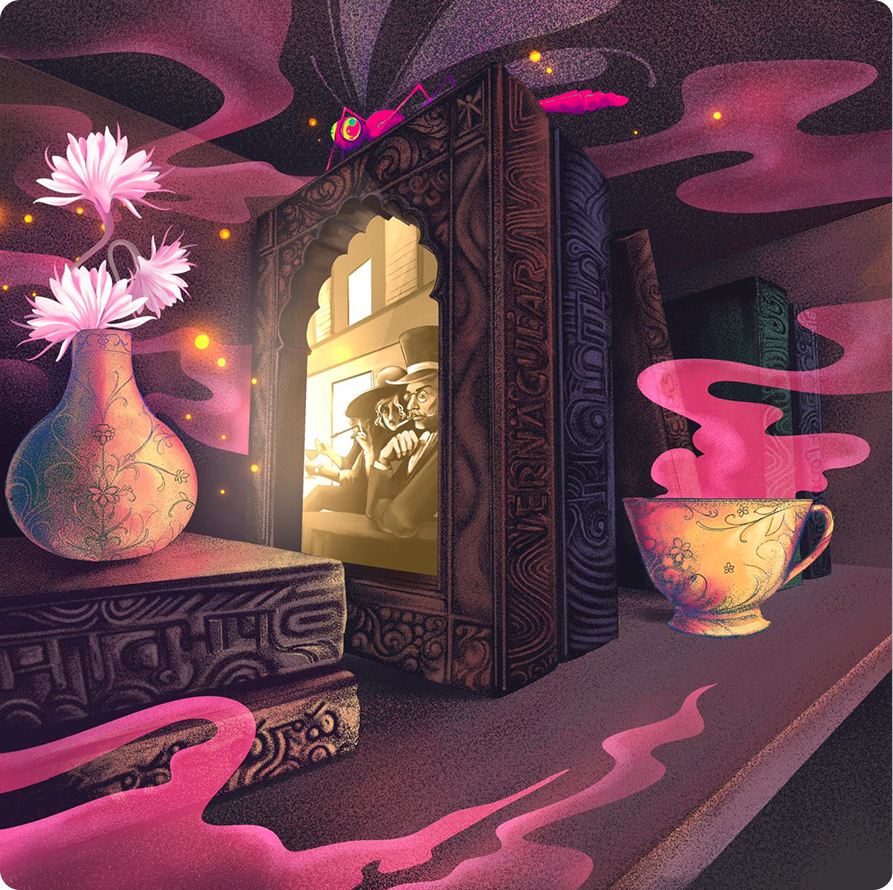
Illustration by Aditya Damle
ENTRY #03:
HABITS
2025-10-10
Words by Jones Benny John
Traditionally, we think of coffee as being South Indian. A syrupy filter coffee, frothed with milk and sugar, accompanies every idli-dosa combination from Kanyakumari to the Konkan. Traditionally, a two-tiered utensil made from brass or stainless steel was used to brew coffee in the South, a mechanism that was later scaled up for use in restaurants. Despite its assumed timelessness, it has been less than a century since this device found popularity, first within privileged kitchens in the Madras Presidency. Before then, traditionally, coffee was a European drink, cultivated along the Western Ghats for export by European planters. A century prior, kahve was a Muslim drink, fervently consumed across Asia’s gunpowder empires, from Algeria to Hyderabad.
Periyar once argued against the needless protest to imported vocabularies in instances when a subject has no distinct vernacular coinage, citing the use of “kaapi” as an example. Kahve, a word that is shared by coffee, tea and wine in the Middle East to indicate the dark colour of these beverages, was butchered a few times in transliteration before formally entering European dictionaries devoid of its descriptive effect. In the five hundred odd years before it became a cultural staple in the vicinity of Madras, coffee represented faith, rebellion and enterprise divergently as it manifested across gradient geographies.
At some point, Tamizh did develop a word for describing coffee, kulambi, that described the beans' resemblance to ruminant hooves, though kaapi remains popular.
We think of coffee as being South Indian, but long before its temperatures were being brought down between brass dabara sets it was a staple in the North. Poets from Delhi and Lucknow composed odes to the drink and its effects in the Persianate vernaculars that preluded Urdu. This memory is faint today, as it barely survives in translation.
In the brief period during which coffee conquered six continents, it has represented devotion, dissent and the dreams we have with our eyes wide open. In the last forty years, across South America, Africa and Southeast Asia, it has come to represent the dreams of those producing it. Through a borrowed vocabulary from the appreciation of fine wines, specialty coffee was born. In the subcontinent, these dreams have been more recent and as such the exclusive privy of relatively larger estates with custodians familiar with urban markets and global trends.
Another reason for this exclusivity has been specialty coffee’s preference of Coffea arabica, a fragile species whose maintenance is seldom afforded by small-holders. This bias was blindly adopted when we began appreciating the coffee for its own flavour, without milk and sugar.
In South India, black coffee is characterised by rich nutty, chocolaty notes rather than complex acidities, dependably vernacular in its seduction rather than suggesting an imported quality. Yet we are encouraged to identify strawberries and maple syrup as cupping notes, to condition our palette as per items standardised by US army canteens
In Vietnam, a phin filter, a drip mechanism akin to the South Indian filter, is used to brew a strong canephora decoction that is drunk with condensed milk and ice. The success of Nguyen Coffee Supply in the US, a project that has served to mitigate some stigma around serving canephora, has made Vietnamese Iced Coffee a common recipe around the world, though most cafes that offer this beverage use arabica espressos as the base.
Today, on most days, I appreciate an unsweetened coffee brewed with canephora beans harvested from Wayanad, concentrated enough to give me jitters for half an hour. A boozy, fermented canephora from the Kerehaklu farm in Chikamagalur, named after an American poet born in Weimar Germany, made me realise I did not really need to find blueberries in my daily cup several years back. My family in Wayanad prefers a sweet diluted cup with sediments loosely settled at the bottom, with milk or as a kattan.
To each, their own Vernacular.
